After parting ways with our tour guide, Carlos and I headed to our private hammam appointment, held in a ritzy riad near the heart of the old medina. Guarded by an enormous black door and the tall walls of the alleyway, the riad opened into a beautiful courtyard with several fountains, where we waited for the hammam to begin.
Hammams are a popular kind of spa-experience in Morocco, and it seems that many people participate in the more traditional hammams held in public bath-houses separated by gender. Ours seemed to be much more geared toward tourists, but it was still unlike any spa or massage I’ve ever had (my closest point of comparison is probably the Ayurvedic massage I had several years ago in India). We were led into a stone, steam-filled room and told to lay down; after about 5-10 minutes, two women came in to douse us in warm water, cover us in soap, and scrub our arms, stomach, and legs. I found it simultaneously calming, refreshing, and stifling. As relaxing as it was to be pampered and exfoliated, I was grateful to stand up and breathe fresh air again. We had tea and pastries in the courtyard afterward.
At the advice of our host, Carlos and I arranged a private guided tour for our second full day in Fes. Our guide grew up in the medina, so he weaved through the streets effortlessly, stopping for a few seconds every now and then to greet someone he knew. Carlos remarked that it was a bit like walking with a local celebrity; in a sea of thousands of people, individuals regularly approached him to kiss his cheek or shake his hand, speaking quickly in Arabic before dissolving into the sea again a moment later.
Our guide explained that there are many neighborhoods within the medina, each containing a mosque and a bakery, separated from one another by stone archways. Carlos asked if there was a map of the medina, and the guide laughed. “There are no maps,” he told us. “The streets of the medina were designed to confuse invaders, even though locals knew the way through. Now they just confuse tourists.”
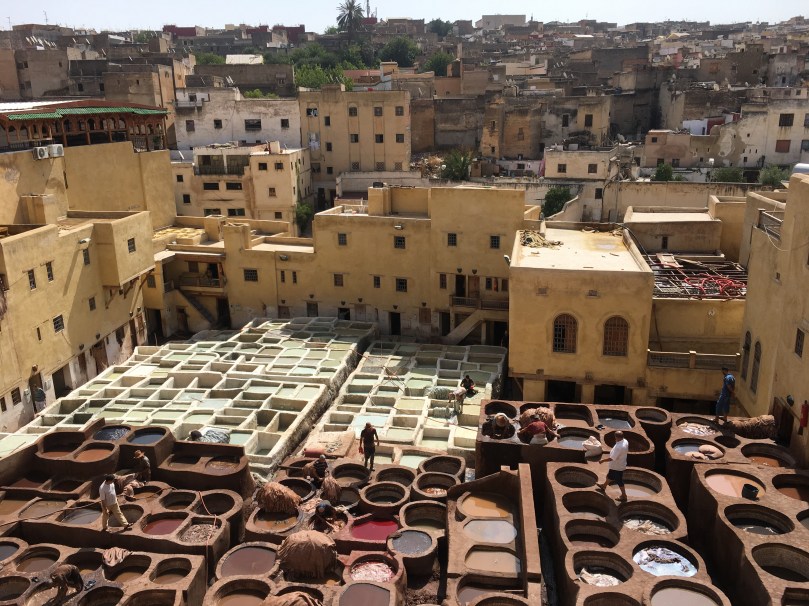
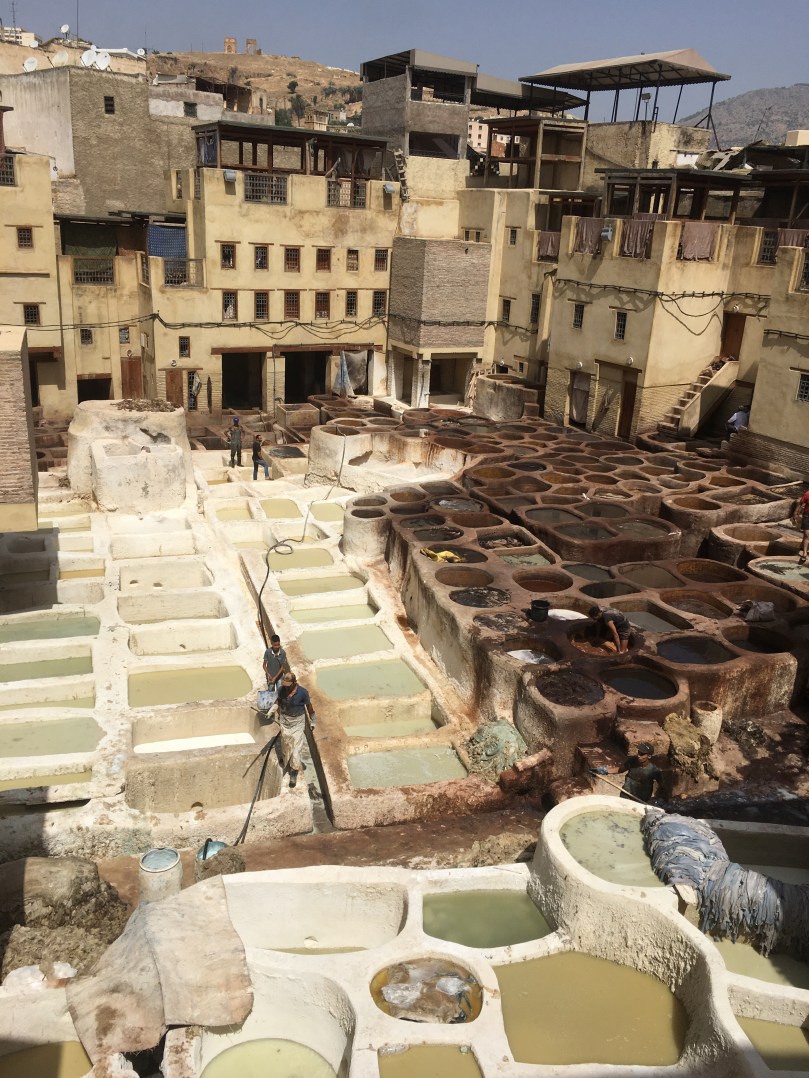
It was hugely beneficial to be able to rely on local expertise during our second medina experience. We were able to see the Fes tannery—about three times the size of the one we saw the previous day—and even when we returned to some sites we’d already seen, we were able to learn more about them the second time around. We saw the weavers again, and this time they told us about the types of thread they use in their work; I was fascinated to see how some scarves are made with agave thread, pulled from the leaf of an agave cactus.
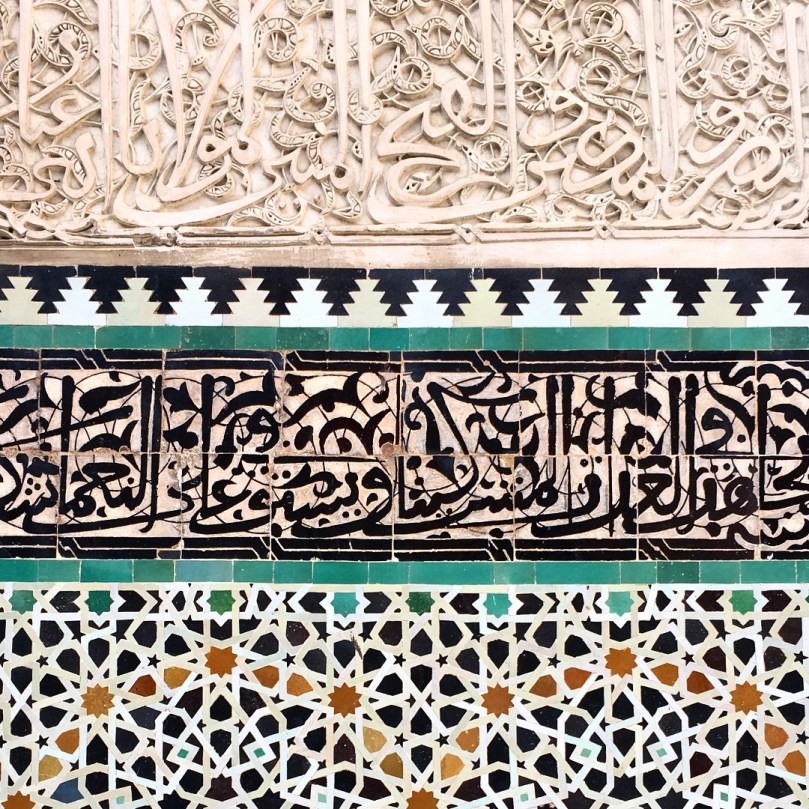
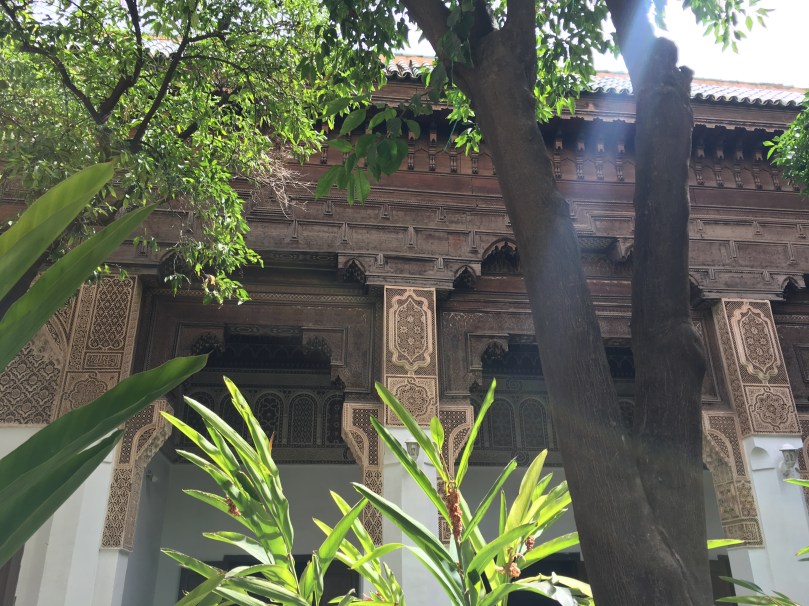
We were taken to the University of al-Karaouine, founded in the year 859 by Fatima al-Fihri; it is the oldest continuously operating university in the world. We also visited another historic madrasa (school) and stood in its courtyard, where our guide explained the significance of the intricate tile designs on the walls and pillars. He pointed to some of the marble decorating the courtyard and explained, “This came from Italy. We traded for it: our sugar for their marble. It was a good deal for us; they no longer have the sugar, but we still have the marble.”
In addition to sharing his vast historical knowledge of the medina, our guide bestowed practical wisdom on us, as well. He informed us that donkeys have the ultimate right-of-way in the narrow medina streets. “If you hear someone on a donkey yelling at you to move, do it right away,” he advised. “If you don’t, it might be the last thing you ever hear.”
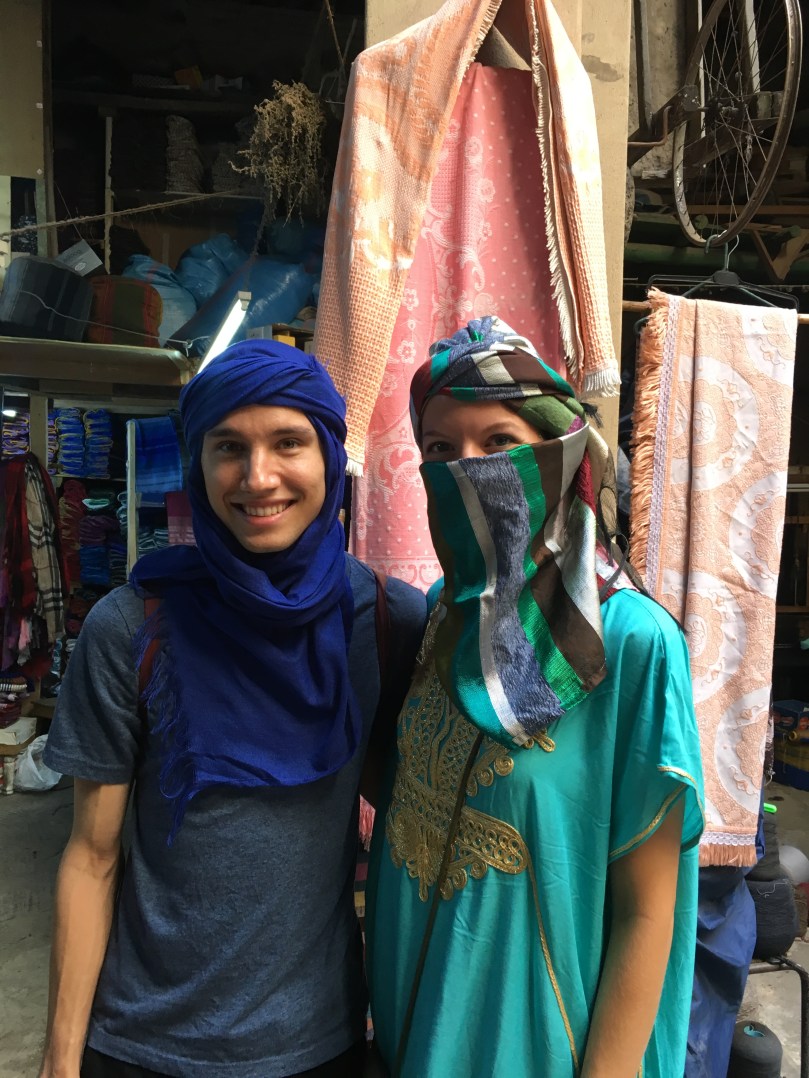
Some tile work and design at the madrasaOne of the weavers showed Carlos and I how to wear the scarves if we needed protection in the desert.The main Fes tannery
We took a train to Fes and arrived in the mid-afternoon. Our host at Dar D’or Fes greeted us at the door and poured us a few cups of mint tea while he advised us on things to do in the city. He asked where we had visited most recently, and when we told him that we’d enjoyed seeing Marrakech, he nodded. “Good,” he said, “Fes is much better. You’ll really like it here.”
We ate dinner at a restaurant called Café Clock, located down a winding alley with the walls painted in vivid rainbow colors. We found a seat on the rooftop terrace, surrounded by plants and a few stray cats. I ordered a banana milkshake with homemade ice cream – perhaps the best milkshake I’ve ever eaten.
The next morning, we were treated to a breakfast comparable to the size of our breakfasts at Riad Jonan. We spent the day wandering the city; I noticed that the souks were interspersed with craftsmen, not only selling but creating the products in the shops. We saw a tannery, wood carvers, metalworkers, weavers, and stone carvers (who we later discovered were carving holy verses into tombstones – I’m glad we didn’t try to haggle with any of them or suggest that we’d like to purchase their work as a souvenir for our friends). When it became very hot, we sought shelter in the woodworking museum, where we learned how wood is used and carved in mosques, homes, festivals, and military ventures.
On our second night, we had the best meal we’d experienced in Morocco. Our host at Dar D’or Fes and his wife cooked an elaborate dinner for us and waited on us at a candlelit table. They served several cold salads (many of which were similar to the ones we’d had at Dar Filali) and then a perfectly flavorful chicken tagine – all created with ingredients fresh from the market that morning.
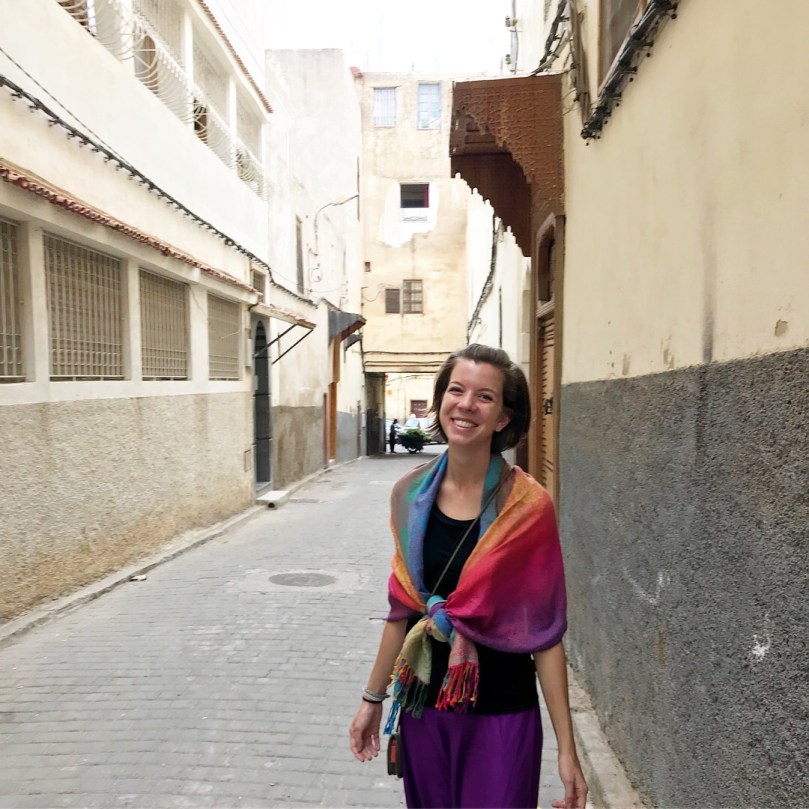
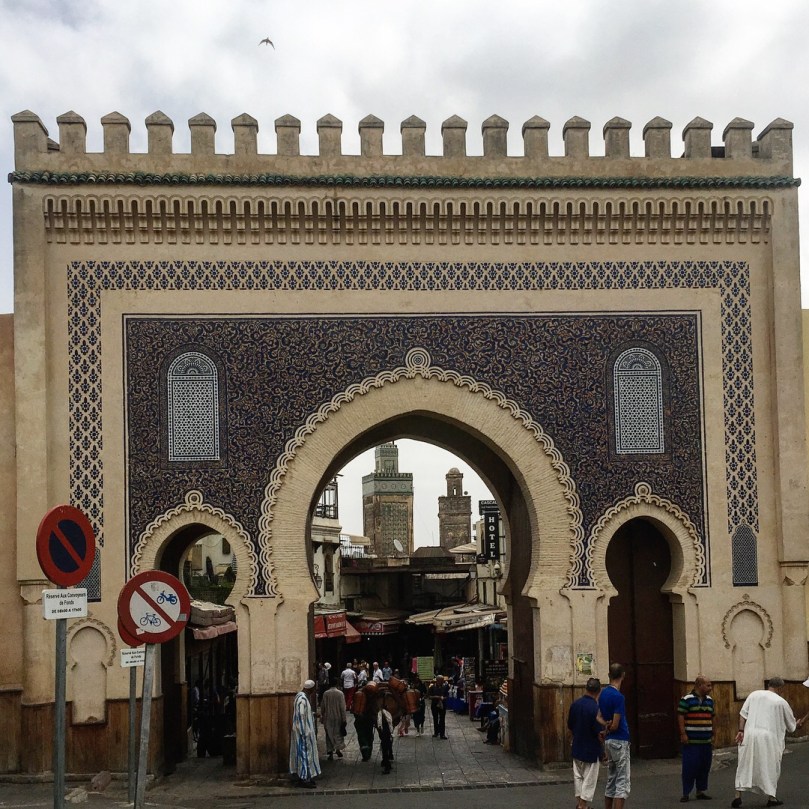
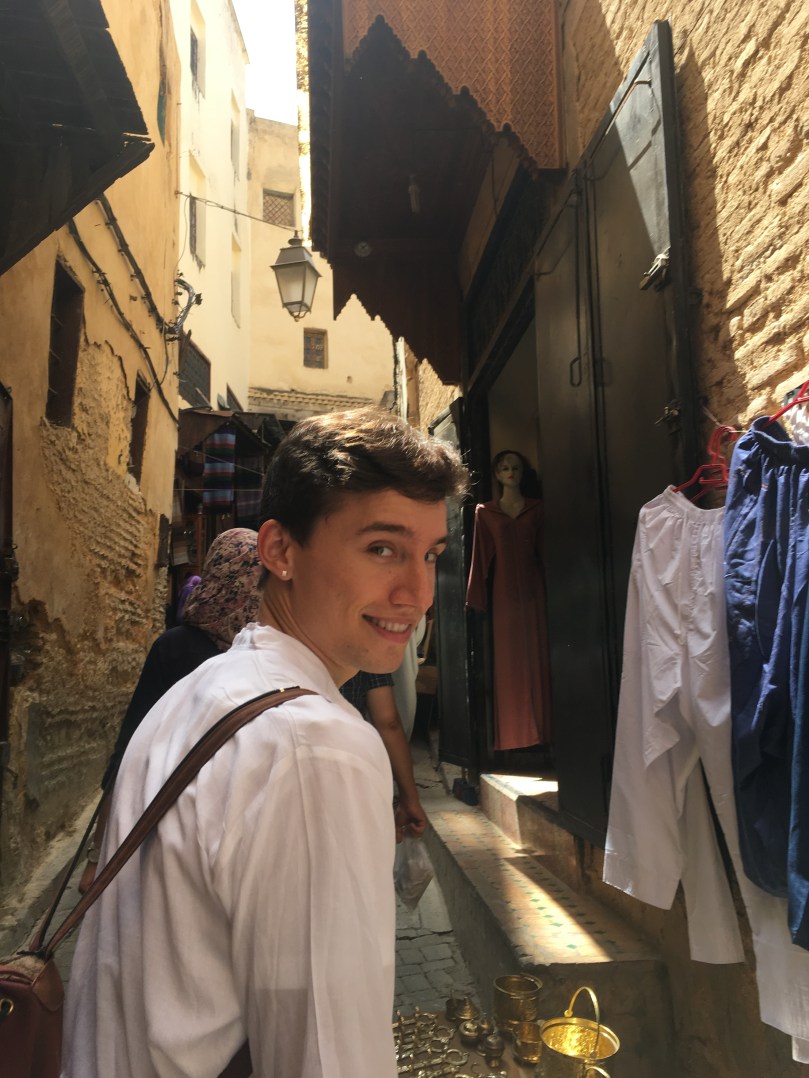
Ready to explore the city!The Blue GateCarlos in the MedinaA Fes Tannery
On our last full day in Marrakech, we decided to visit Bahia palace, one of several renowned palaces in the area. As we explored the grounds, we stumbled into a tour group led by an enthusiastic young man who animatedly told stories about the clever but rather gluttonous ruler who once lived there. He seemed to enjoy having Carlos and me as an addition to the group, remarking that he was pleased to see us so happy. Looking around at other members of the tour, I could understand how we might have offered something of a respite. A few pre-teens dragged their feet behind exhausted-looking parents; a blonde woman wearing a shirt that said, “Smile!” glared at the guide each time he spoke; and one confused-looking man followed the group at a distance, who (our dismayed guide later informed us) did not speak English. “You have just one day in Marrakech,” he chided the crowd. “Please, be happy!”
After we finished the tour of the palace, our guide excitedly showed Carlos and me pictures of the friends he’d made in his English/Arabic immersion program, then told us to wait a few minutes so that he could escort us to the next location. Around this time, I began to wonder if this wasn’t a standard palace tour; I noticed that the other tour participants wore wristbands and had likely paid for a more extensive experience. Still, our guide seemed intent on taking Carlos and I with them to the next place, so we followed him into the souks, stopping with the group at a bakery and pharmacy along the way. About an hour later, we decided to break off from the group; we placed a substantive tip in the guide’s hand and scampered away to avoid questioning.
That night, we had dinner at a restaurant hidden within the alleyways of the souks, which opened into a garden-like courtyard. We split a date milkshake and tried a dish called “pigeon pie,” a pastry covered with cinnamon and sugar and filled with pigeon, raisins, and other savory flavors. We agreed it was a worthwhile experience – but probably not a dish we’d order again.
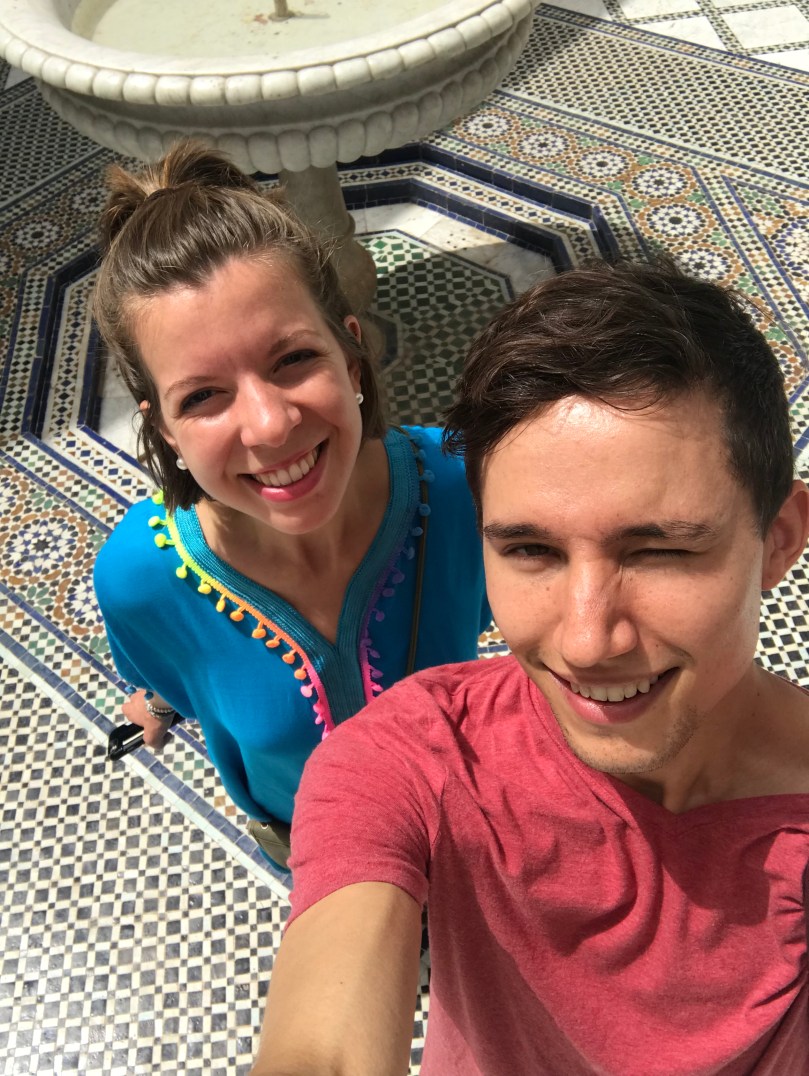
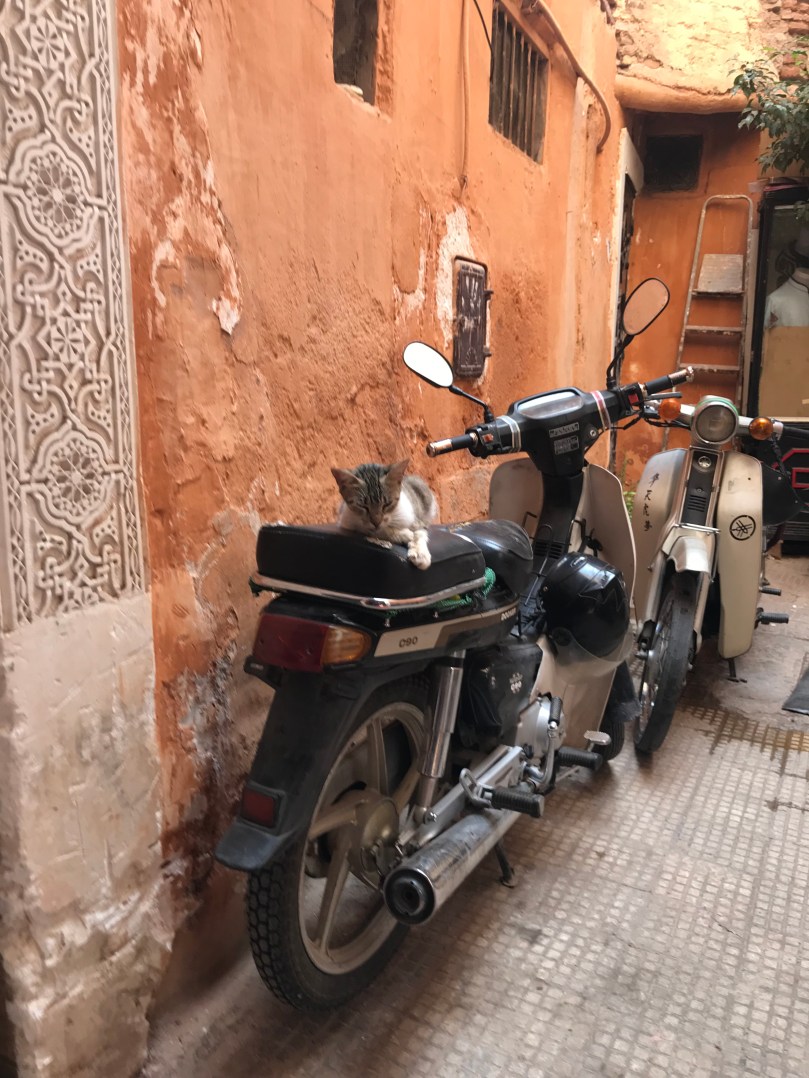
Bahia PalaceAnother shot of the Bahia Palace — Reminds me of a Wes Anderson film.Carlos and me! Some tiled floor in the backgroundCats are everywhere in Morocco. Here’s one on a motorcycle.
We had an elaborate breakfast laid out for us the following morning: eggs, crepes, yogurt, several different kinds of bread, olives, jam, coffee, and juice. Although it seemed excessive at the time, I was grateful for the nourishment as we entered the souks and started haggling.
The souks are truly overwhelming. We found many of the shopkeepers to be pushy but friendly. Even after talking one man down from 1200 to 400 dirhams, he shook our hands and wished us a happy journey in Marrakech. We experienced this kind of hospitality outside of the souks, too; a teenage boy sitting on a stoop near our riad called out to us one night as we passed him: “Marrakech is a good city – I hope you like it here. A thousand welcomes!”
“A thousand thank-yous!” Carlos responded.
It was fascinating just to wander through the streets of the souks, and even with Google maps, it was nearly impossible not to get lost. We wondered at walls of carpets, shelves upon shelves of leather shoes, and extraordinary amounts of colorful kaftans (long loose-fitting dresses worn by many Moroccan women). Pastries, fruit, teacups, and trinkets also lined the streets. One of the main challenges we experienced, though, was not knowing how to determine the value of things that if mass produced could be worth less than 20 dirhams and if handcrafted could be worth upward of 200.
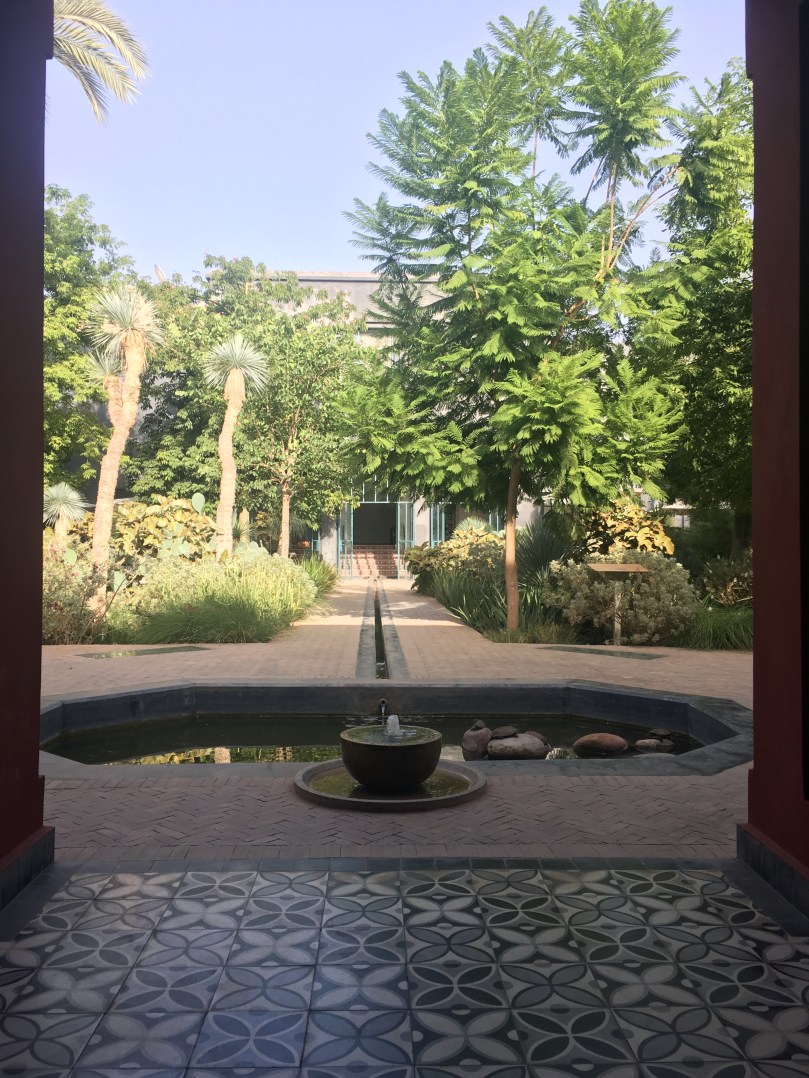
One of the most magical aspects of the souks was their ability to conceal unexpected wonders. We stumbled upon breathtakingly beautiful original works of art, and we even met a shopkeeper who gave us a gift without us purchasing anything. We found a “secret garden” hidden behind one gate, providing a drastic juxtaposition to the narrow, bustling streets a few steps away. Carlos and I walked through the garden and realized that it was connected to a palace with a tower that provided a panoramic view of the entire city.
Our tower tour guide explained to us the significance of the architecture, and also shared stories from his own life. He had spent some time in Europe, and although he enjoyed his time there, he decided to stay in Morocco. One of the tour participants asked if he had plans to return to Europe. “No,” he said seriously. “I have six children, and I cannot leave them.”
I was surprised; he looked to be in his mid-twenties.
“They are all Labrador retrievers,” he continued. “Every night, I come home to them and I play my guitar. They sit around me in a circle as I sing. I could never leave them.”
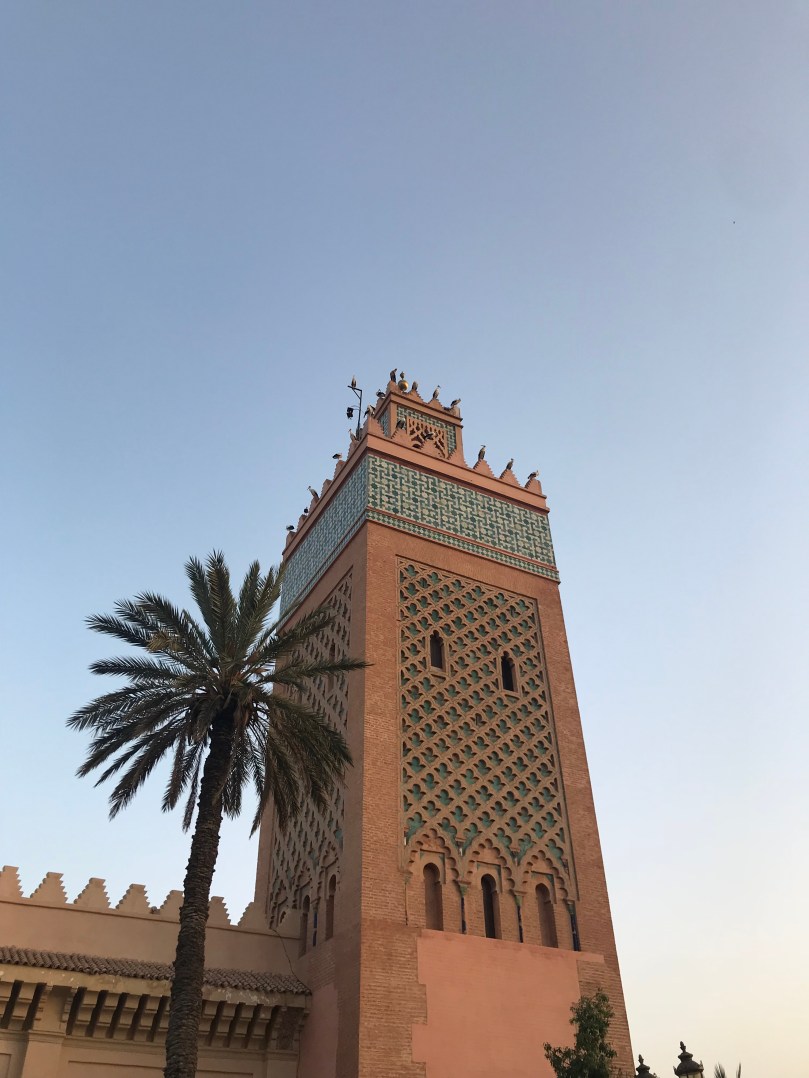
Le Jardin SecretThe mosque in our neighborhood — Moulay El Yazid Mosque
Carlos and I took the train from Casablanca to Marrakech. The landscape between the two cities seemed to be pretty sparse, with vast red plains and a few hills scattered by intermittent farm animals, palm trees, and cacti. The austerity of the journey made pulling into the city an especially magnificent sight. I was struck by the overwhelming liveliness of Marrakech, particularly in its bustling streets and a confusing preponderance of horse-drawn carriages.
We stayed in a riad instead of a hotel; the closest equivalent to this in the U.S. is probably a bed and breakfast with an urban but personal touch. Riad Jonan is set in the old city, surrounded by little restaurants and markets, and just a short walk away from the famous Marrakech souks (roadside shops selling everything from carpets to juice to jewelry where tourists and locals alike haggle with shopkeepers). The riad is hidden from view of the main street, located down a few narrow alleyways lined with doors; one wrong step and you could accidentally stumble into someone’s living room.
Yassin welcomed us into the space. His colleague carried our bags to our room while he served us mint tea and pastries, pointing out some of Marrakech’s main attractions to us on a map. He informed us that breakfast is served between 8 and 10:30 AM. He paused for a few moments as if debating something in his mind, then added, “But if you want breakfast after 10:30, I’ll still make it for you.”
We decided to poke around in some of the shops after checking in. One shopkeeper invited us inside, gave us tea to drink, and allowed us to sample many of his products, including menthol crystals and argon oil. We ended up purchasing some of the crystals, since Carlos had a cold and found that it helped his sinuses.
Around 7 PM, we decided to eat dinner. We found a nearby restaurant with rooftop seating and water misters, which offered a welcome respite from the Marrakech heat. Carlos and I puzzled over why the place was almost empty; we’d had the same experience every other time we’d eaten dinner, as well. We realized soon thereafter that Moroccans don’t usually eat dinner until around 9 PM.
We spent the first full day of our honeymoon exploring Casablanca on foot. We briefly got lost in the twists and turns of the crowded markets and medina streets, but found ourselves in time for lunch at La Sqala, where we had freshly squeezed fruit juice and more tagine. (Even when we were lost, I don’t believe we were ever more than 50 meters away from someone offering juice and/or mint tea.) Although we didn’t go inside, we walked past Rick’s Café, a restaurant designed as a near-replica of the bar in the film Casablanca.
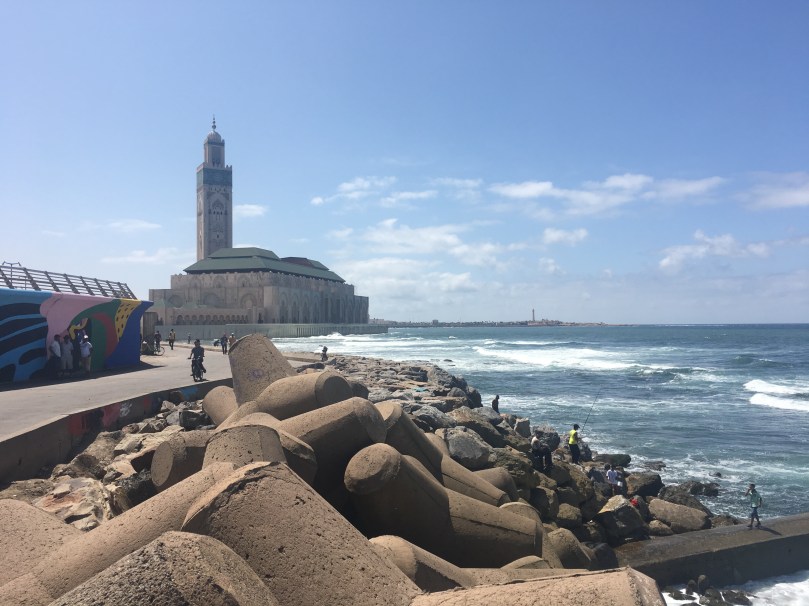
However, our main adventure for the day was touring the Hassan II mosque. Even the underwhelmed online reviewers of Casablanca begrudgingly admitted that it is a great sight to behold. Located on the edge of the Atlantic Ocean, Hassan II is the largest mosque in Morocco and either the third- or fifth-largest in the world (depending on the source). It’s also one of few mosques that non-Muslims are permitted to enter. Carlos and I arrived at prayer time, so we weren’t allowed inside immediately, but we were able to join a tour in the mid-afternoon.
Our tour guide spoke 11 languages and was able to answer every question about the history, architecture, and present-day usage of the mosque. It was built relatively recently in honor of the previous king of Morocco, and construction ended in the 1990s. Its minaret stands at 210 meters – the tallest in the world. As is customary, the imam and Muslim worshippers pray facing Mecca at the front of the mosque. The guide explained that the Hassan II mosque contains a special door that is used only by the king. When the king visits, he walks through the door and across a designated path on the floor bordered by water. When the king is not preset, the door remains closed and the pathway dry. “This king guy sounds pretty important,” Carlos observed.
Pictures were allowed in the mosque, but I took very few since I don’t think my phone could do justice to the intricacy of the tilework and architecture. I think I was able to capture the essence of the outside a bit better.
Carlos and I landed in Morocco after a seven-hour overnight flight. We spent our first two nights in Casablanca, against the advice of nearly everyone on the internet. When we’d search for sightseeing ideas in online forums, at least 30% of respondents urged us to leave Casablanca immediately and travel to a more exciting area like Marrakech or Fes. It’s not an unfriendly city, but it’s certainly not the pride and joy of Morocco. The overall vibe of the region could be characterized by the statement: “Welcome to Casablanca… Are you sure you’re in the right place?”
Despite the warnings of well-meaning strangers, Carlos and I had a fun time in the city. On our first evening in Morocco, we walked to a restaurant called Dar Filali, where we met Mr. Filali himself. He ushered us into the restaurant and introduced us to his son, Muhammad, who seated us at the restaurant’s singular balcony table. Muhammad gave us a tour of the place and explained the historical significance of this building and others in the neighborhood; the edifice across the street was the first building established by the French during their occupation of Morocco in 1921. After our tour, Muhammad asked if there was anything we couldn’t eat. When we said no, he assured us that he would take care of us and introduce us to a variety of Moroccan dishes.
Our servers were two young women who seemed delighted by my interest in the Arabic language. They taught us how to say “good” (mezzien), “delicious” (benin), and “Eat!” (Kuli!). In low voices, they taught me how to talk about “a man who is trouble.” When I said the words to Carlos, they erupted into laughter; I asked if it was a bad thing to say, and they laughed again. “Yes,” they said, “Don’t say it anymore!”
They also directed our attention to Arabic proverbs which decorated the walls of the restaurant. They translated a few for us, explaining that they could be difficult to understand at first, but encouraging us to look for the deeper meaning. One said: “When you are hungry, eat pomegranate. When you are not hungry, eat pomegranate.”
“You see, pomegranate seeds are very small,” our server explained wisely.
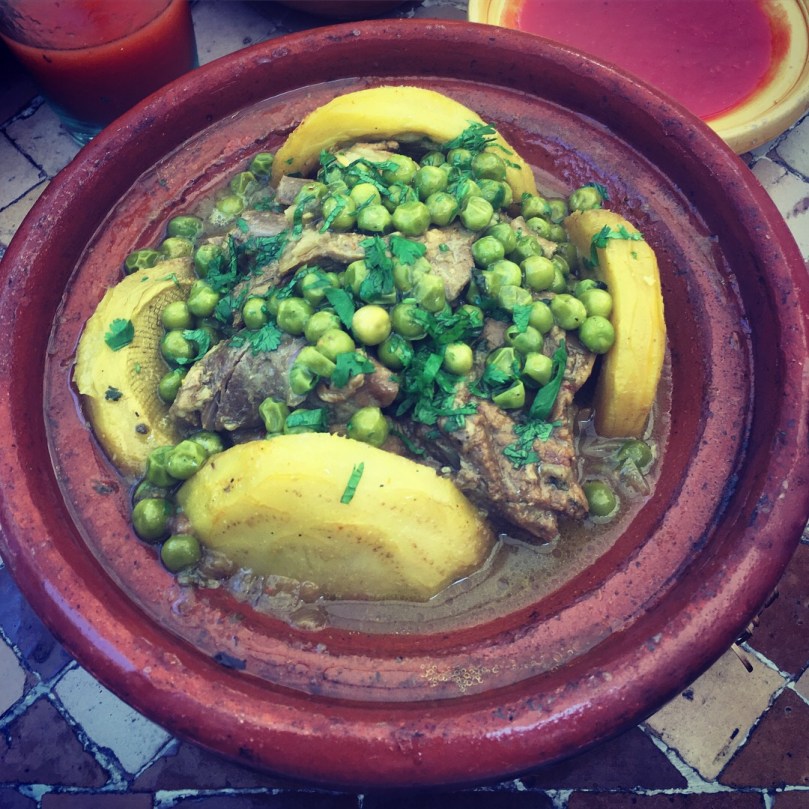
Dinner was delicious. We ate several cold salads containing eggplant, potatoes, beets, and tomatoes; I probably would have been content solely with these. Our main course, however, was even better. We each had our own tagine, a traditional Moroccan dish served in a distinctly shaped clay pot surrounded by vegetables, olives, and a flavorful broth. Our servers showed us the correct way to eat the tagine by ripping off a piece of bread and using it to transport the meat from dish to mouth.
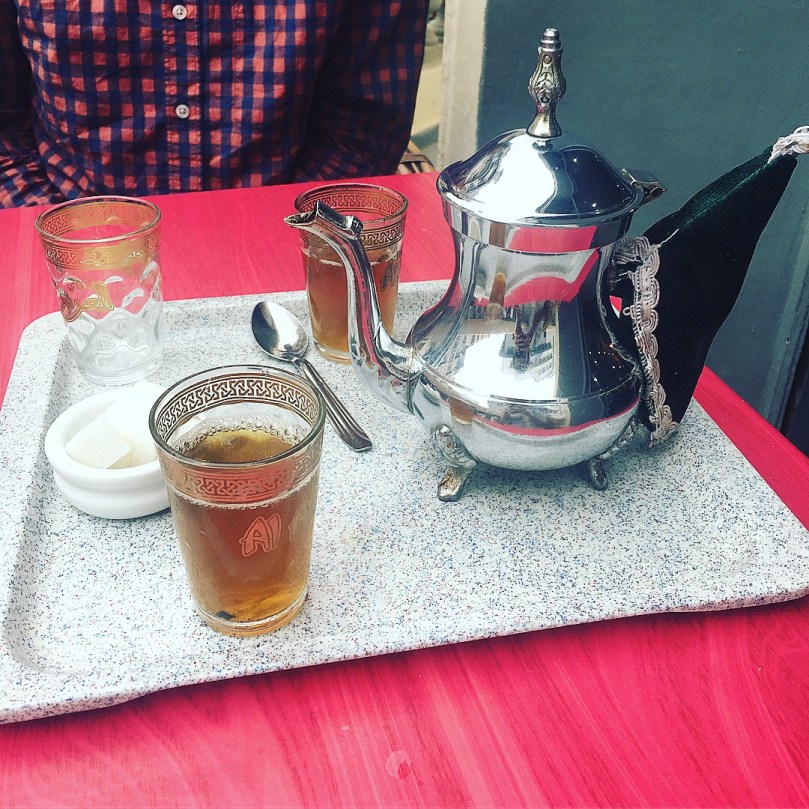
After our meal, we were treated to a pot of Moroccan mint tea and a cold dessert called jawhara; these were on the house as a honeymoon gift to us. Both were sweet and refreshing. We learned that the proper way to pour mint tea is to hold the pot about a foot above the glass and pour; this way, bubbles form on top of the tea.
Upon leaving the restaurant, we saw Mr. Filali once again. He high-fived us and invited us back again anytime. “This is a good man,” he told me, patting Carlos on the shoulders.

 Laura and Carlos: Adventure Tracker